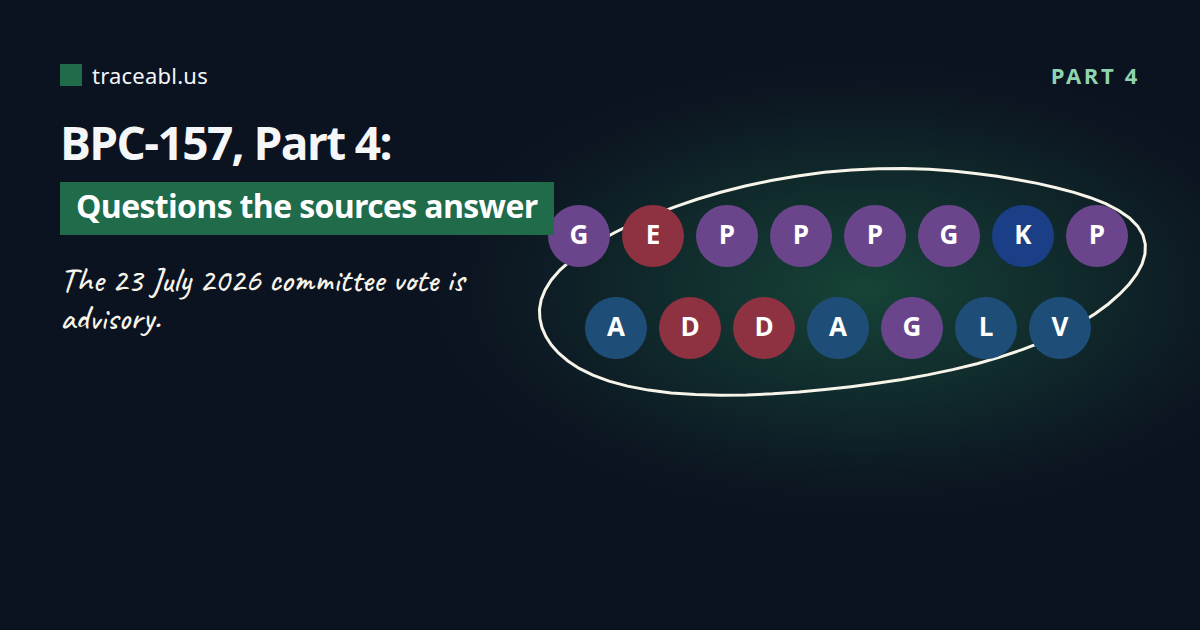
The first three parts covered the sequence, the published record, and the HPLC-UV calculation. These are the questions that come up from those same sources. Where a source was not found, the gap is stated rather than filled in.
Is BPC-157 an approved drug?
No. It is not an FDA-approved drug for any use.[1] A 2026 review found no approved formulation and no completed Phase II trial.[2] The World Anti-Doping Agency names it under S0, non-approved substances, prohibited at all times.[3]
What did the July 2026 committee vote change?
On 23 July 2026, FDA's Pharmacy Compounding Advisory Committee voted 8–6, with 1 abstention, to recommend adding BPC-157, free base and acetate, to the 503A bulks list. The vote is advisory. Adding a substance requires notice-and-comment rulemaking.[4][5] No final rule was identified in the review dated 26 September 2026. Removal from Category 2, confirmed on 15 April 2026, does not place the substance in Category 1.[4]
Which molecule does the fact box describe?
The fact box in part 1 is the free peptide on PubChem CID 9941957: C62H98N16O22, 1419.5 g/mol, CAS 137525-51-0.[6] The committee reviewed both the free base and the acetate. A salt does not have the same mass as the free peptide. The series mark does not draw an acetate rim, because the sources do not fix one salt as the structure of this entry.
What does an HPLC-UV percentage leave out?
The area percent is the main peak divided by the integrated peak area. It is not a count of milligrams in a container, and it does not by itself prove that the main peak is this sequence rather than a close deletion. It does not measure water, non-absorbing counter-ions, or endotoxin. Part 3 walks through that calculation. No published storage-stability study of the dry peptide, or of a solution, was identified for this series. Stability reported in gastric juice describes a biological fluid, not a stored container.[2]
The 1993 paper introduces a fragment. The 2025 review counts the studies and reports no clinical safety data.[1][2] The committee vote is advisory, not a final rule.[4] The area percent is a ratio of peak areas.
In the news
Each item below was checked against the source named with it. The labs are in Part 2, Who did the research.
1 January 2026. The World Anti-Doping Agency's 2026 Prohibited List came into effect. Section S0, non-approved substances, names BPC-157. That class is prohibited at all times, in and out of competition.[3]
23 July 2026. FDA's Pharmacy Compounding Advisory Committee met on BPC-157 free base and BPC-157 acetate for the 503A bulks list. FDA's briefing for the meeting proposed that neither form be added.[7] The committee voted 8–6, with 1 abstention, to recommend adding both. The vote is advisory. Adding a substance takes notice-and-comment rulemaking.[4][5]
2025. Lee and Burgess published a pilot in two adults. On one day they infused 10 mg of BPC-157 in 250 mL of saline over one hour, and 20 mg the next day. They measured vital signs and blood markers of the heart, liver, kidneys, thyroid, and blood glucose.[8]
2 February 2026. Hudson Biotech registered a Phase 2 trial, NCT07437547, and listed it as recruiting. The record describes a randomized comparison of BPC-157 and placebo after an MRI-confirmed grade II hamstring strain. The measurements named in the record are time to return to sport and injury volume on MRI. No results are posted.[9]
Exposure to heat, moisture, and repeated temperature changes can change a peptide sample after it is tested. A result describes the sample on the day it was tested. Handling for shipment to a laboratory is described in the shipping guide.
References
- Vasireddi N, Hahamyan H, Salata MJ, et al. Emerging Use of BPC-157 in Orthopaedic Sports Medicine: A Systematic Review. HSS J. 2025;21:485–495. https://doi.org/10.1177/15563316251355551 (PMID 40756949)
- Mateescu DM, et al. BPC-157 as an Investigational Peptide Therapeutic: Biopharmaceutical Challenges, Formulation Strategies, and Translational Development Barriers. Pharmaceutics. 2026;18:625. https://doi.org/10.3390/pharmaceutics18050625 (PMID 42198317)
- World Anti-Doping Agency. 2026 Prohibited List, section S0 (in force 1 Jan 2026). https://www.wada-ama.org/en/resources/world-anti-doping-code-and-international-standards/prohibited-list
- McDermott Will & Schulte. PCAC backs majority of peptides in two-day public meeting (2026). https://www.mcdermottlaw.com/insights/bulk-list-bound-pcac-backs-majority-of-peptides-in-two-day-public-meeting/
- Mondaq. FDA Advisory Committee Voted Yes On Six Peptides. Now What? (2026). https://www.mondaq.com/unitedstates/healthcare/1832514/fda-advisory-committee-voted-yes-on-six-peptides-now-what-the-regulatory-road-ahead
- PubChem. BPC-157, CID 9941957. https://pubchem.ncbi.nlm.nih.gov/compound/9941957
- U.S. Food and Drug Administration. Pharmacy Compounding Advisory Committee briefing document, 23–24 July 2026. https://www.fda.gov/media/193342/download
- Lee E, Burgess K. Safety of Intravenous Infusion of BPC157 in Humans: A Pilot Study. Altern Ther Health Med. 2025;31(5):20–24. https://pubmed.ncbi.nlm.nih.gov/40131143/ (PMID 40131143)
- ClinicalTrials.gov. NCT07437547, BPC 157 for acute hamstring muscle strain repair. First posted 2026. https://clinicaltrials.gov/study/NCT07437547