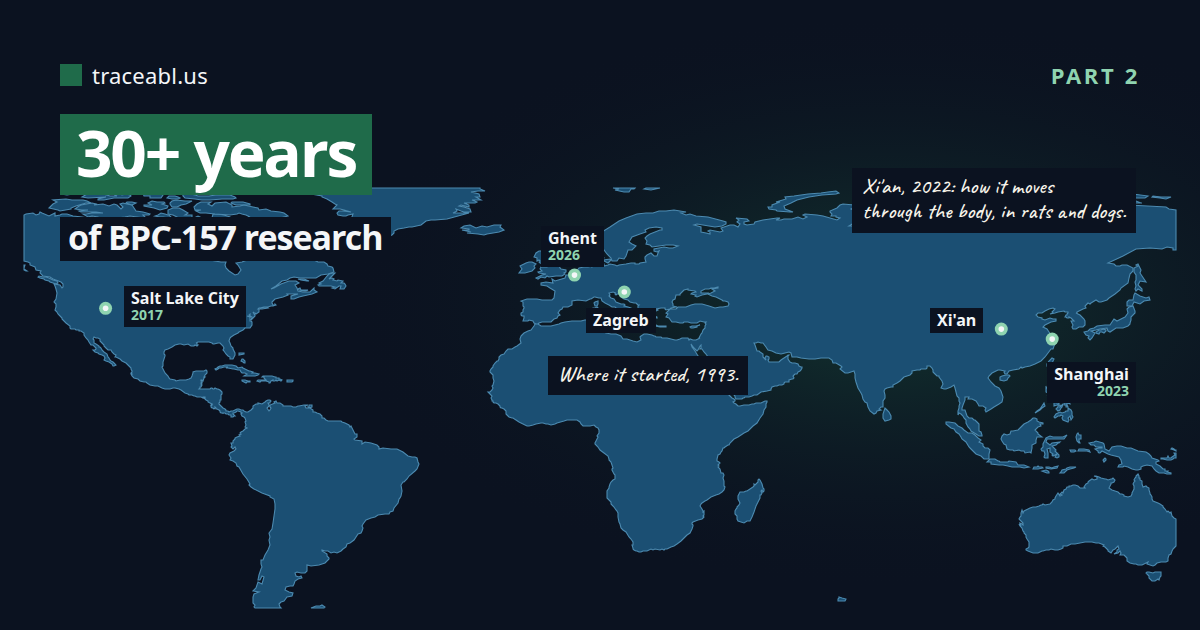
Part 2 follows who studied BPC-157, and what each group measured. Recent dates are in In the news on Part 4.
The Zagreb group
In 1993, a pharmacology group at the University of Zagreb's School of Medicine, led by Predrag Sikirić, described a stomach-juice peptide they named BPC, and a 15-amino-acid fragment of it, BPC 157.[1]
The same department has kept publishing on that fragment. A 2026 review, counting papers by author affiliation, reports that more than 80% of published BPC-157 studies come from this group.[2]
Most of the work is in rodent models. The topics cover the stomach and gut, tendon, ligament, and muscle, and also heart and nervous-system models.[2] A 2022 review from the department gathers the rat studies on striated muscle, smooth muscle, and heart muscle, including tendon-to-muscle junctions.[7]
The Xi'an group
In 2022, a team at the School of Pharmacy, Air Force Medical University in Xi'an, with colleagues at Shaanxi University of Chinese Medicine, asked a basic question: once BPC-157 is administered, where does it go, and how long does the intact peptide last?[3]
They made the peptide by solid-phase synthesis. In Sprague-Dawley rats and beagle dogs they gave it into a vein and into muscle, including seven days of repeat administration into muscle. The intact peptide's half-life in the blood was under 30 minutes. After an injection into muscle, about 14–19% reached the blood in rats and 45–51% in dogs. With a radioactively tagged version, they traced it breaking into small fragments, then single amino acids, and leaving mainly in urine and bile.[3]
The authors describe the work as "the first analysis of the pharmacokinetics of BPC157".[3]
In 2020, many of the same authors published animal toxicity studies in mice, rats, rabbits, and dogs. The tests covered single and repeated administration, the injection site, genetic toxicity, and developing embryos.[4]
Salt Lake City
In 2017, Holly Cox, Geoff Miller, and Daniel Eichner at the Sports Medicine Research and Testing Laboratory in Salt Lake City set out to detect BPC-157 in the kinds of samples an anti-doping lab receives.[5]
They identified the peptide, sequence GEPPPGKPADDAGLV, in confiscated vials. In plasma incubations it formed a breakdown product they could look for in urine. They validated a weak cation-exchange extraction for urine, with a detection limit of 0.1 ng/mL. Measuring that product alongside the intact peptide made the test more specific. BPC-157 in urine was still measurable after at least four days.[5]
Shanghai
In 2023, the Shanghai Anti-Doping Laboratory at Shanghai University of Sport mapped how BPC-157 breaks apart outside the body, so a doping test could look for the pieces.[6]
They used a version tagged with heavy carbon and nitrogen, and incubated it with human liver microsomes and with human skin S9. A search for the light-and-heavy pairs found nine breakdown products: eight from the usual splitting of amide bonds, and one from a pathway the authors describe as new. They then validated a urine method for the intact peptide and five of those products.[6]
Ghent
In 2026, Monica Mazzarino, Thibo Colpaert, Koen Deventer, and Peter Van Eenoo at Ghent University built one analytical workflow for peptide and non-peptide doping agents in blood, and included BPC-157.[8]
They compared liquid serum, plasma, and dried blood spots. At 4 °C and at 22 °C, BPC-157 broke down completely in serum and not in plasma. In the dried spots it stayed detectable through the study.[8] Part 3 uses that comparison when it turns from gastric juice to a stored sample.
What's being learned
More than three decades on, the published record is still mostly one group's rodent models, plus later work on how the peptide moves through rats and dogs, animal toxicity tests, and ways to detect it and its breakdown products.
Part 3 looks at one of its more unusual traits: how well it holds up in gastric juice, and what its sequence may have to do with it.
Next: Part 3, Four prolines and gastric juice.
References
- Sikirić P, Petek M, Rucman R, et al. A new gastric juice peptide, BPC. An overview of the stomach-stress-organoprotection hypothesis and beneficial effects of BPC. J Physiol Paris. 1993;87(5):313–327. https://doi.org/10.1016/0928-4257(93)90038-u (PMID 8298609)
- Mateescu DM, Gavrilescu DM, Constantinescu FE, et al. BPC-157 as an Investigational Peptide Therapeutic: Biopharmaceutical Challenges, Formulation Strategies, and Translational Development Barriers. Pharmaceutics. 2026;18(5):625. https://doi.org/10.3390/pharmaceutics18050625 (PMID 42198317)
- He L, Feng D, Guo H, et al. Pharmacokinetics, distribution, metabolism, and excretion of body-protective compound 157, a potential drug for treating various wounds, in rats and dogs. Front Pharmacol. 2022;13:1026182. https://doi.org/10.3389/fphar.2022.1026182 (PMID 36588717)
- Xu C, Sun L, Ren F, et al. Preclinical safety evaluation of body protective compound-157, a potential drug for treating various wounds. Regul Toxicol Pharmacol. 2020;114:104665. https://doi.org/10.1016/j.yrtph.2020.104665 (PMID 32334036)
- Cox HD, Miller GD, Eichner D. Detection and in vitro metabolism of the confiscated peptides BPC 157 and MGF R23H. Drug Test Anal. 2017;9(10):1490–1498. https://doi.org/10.1002/dta.2152 (PMID 28035768)
- Tian T, Jing J, Li Y, et al. Stable Isotope Labeling-Based Nontargeted Strategy for Characterization of the In Vitro Metabolic Profile of a Novel Doping BPC-157 in Doping Control by UHPLC-HRMS. Molecules. 2023;28(21):7345. https://doi.org/10.3390/molecules28217345 (PMID 37959764)
- Staresinic M, Japjec M, Vranes H, et al. Stable Gastric Pentadecapeptide BPC 157 and Striated, Smooth, and Heart Muscle. Biomedicines. 2022;10(12):3221. https://doi.org/10.3390/biomedicines10123221 (PMID 36551977)
- Mazzarino M, Colpaert T, Deventer K, Van Eenoo P. Rapid and harmonized analytical workflow for the determination of peptidic and non-peptidic doping agents in dried and liquid blood matrices. Analyst. 2026;151(15):4398–4413. https://doi.org/10.1039/d6an00455e (PMID 42328738)