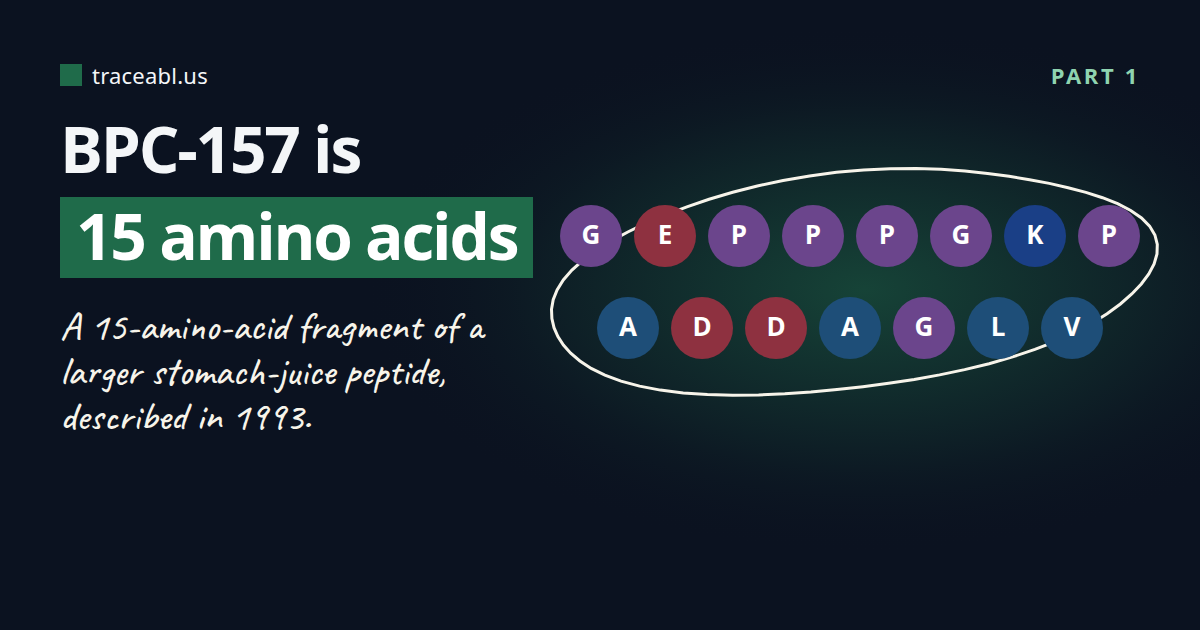
- Glycine, Special. Gly
- Glutamic acid, Negative. Glu
- Proline, Special. Pro
- Proline, Special. Pro
- Proline, Special. Pro
- Glycine, Special. Gly
- Lysine, Positive. Lys
- Proline, Special. Pro
- Alanine, Hydrophobic. Ala
- Aspartic acid, Negative. Asp
- Aspartic acid, Negative. Asp
- Alanine, Hydrophobic. Ala
- Glycine, Special. Gly
- Leucine, Hydrophobic. Leu
- Valine, Hydrophobic. Val
- Hydrophobic
- Polar
- Positive
- Negative
- Special
Where it came from
In 1993, Predrag Sikirić and colleagues at the University of Zagreb's Medical Faculty published an overview of an idea they called the "stomach-stress-organoprotection hypothesis." In it they described a stomach-juice peptide they named BPC, short for "body protection compound," with a molecular weight of about 40,000. They also reported a fully characterized 15-amino-acid fragment of it, BPC 157, which they believed was essential to the larger peptide's activity.[2]
The sequence
Here's the sequence:
Gly-Glu-Pro-Pro-Pro-Gly-Lys-Pro-Ala-Asp-Asp-Ala-Gly-Leu-Val
In order, the residues are glycine, glutamic acid, proline, lysine, alanine, aspartic acid, leucine, and valine.
Four of the 15 are proline. The ring on the emblem above is drawn from this same sequence, with one arc for each amino acid.
The fact box is the free peptide. A salt form, such as the acetate, has a different weight because the salt's counter-ion is part of what's weighed.
The sequence has no cysteine, methionine, tryptophan, asparagine or glutamine.[1] Those are the building blocks most often involved in two common ways peptides break down, oxidation and deamidation. Part 3 comes back to that.
Since 1993
Most research since then has used cells and rodents. Part 2 follows that work from the Zagreb group to other labs.
References
- PubChem. BPC-157, CID 9941957. https://pubchem.ncbi.nlm.nih.gov/compound/9941957
- Sikirić P, Petek M, Rucman R, et al. A new gastric juice peptide, BPC. An overview of the stomach-stress-organoprotection hypothesis and beneficial effects of BPC. J Physiol Paris. 1993;87:313–327. https://doi.org/10.1016/0928-4257(93)90038-u (PMID 8298609)