A way to remember it
Most peptides break down fast in gastric juice. BPC-157 is reported to last more than a day.
Part 3 is about four prolines in the sequence, and what researchers report about gastric juice.
More than a day in gastric juice
Gastric juice is harsh on peptides: acid at pH 1–2, plus pepsin and other protein-cutting enzymes. Most therapeutic peptides break down quickly there.[2]
BPC-157 is an exception. The Zagreb group that discovered it reports its "stability in human gastric juice for periods of time longer than 24 h".[1] A 2026 review describes "unusual stability in gastric juice" and calls it the molecule's most distinctive, well-documented property.[2]
Four prolines
Here's the sequence:
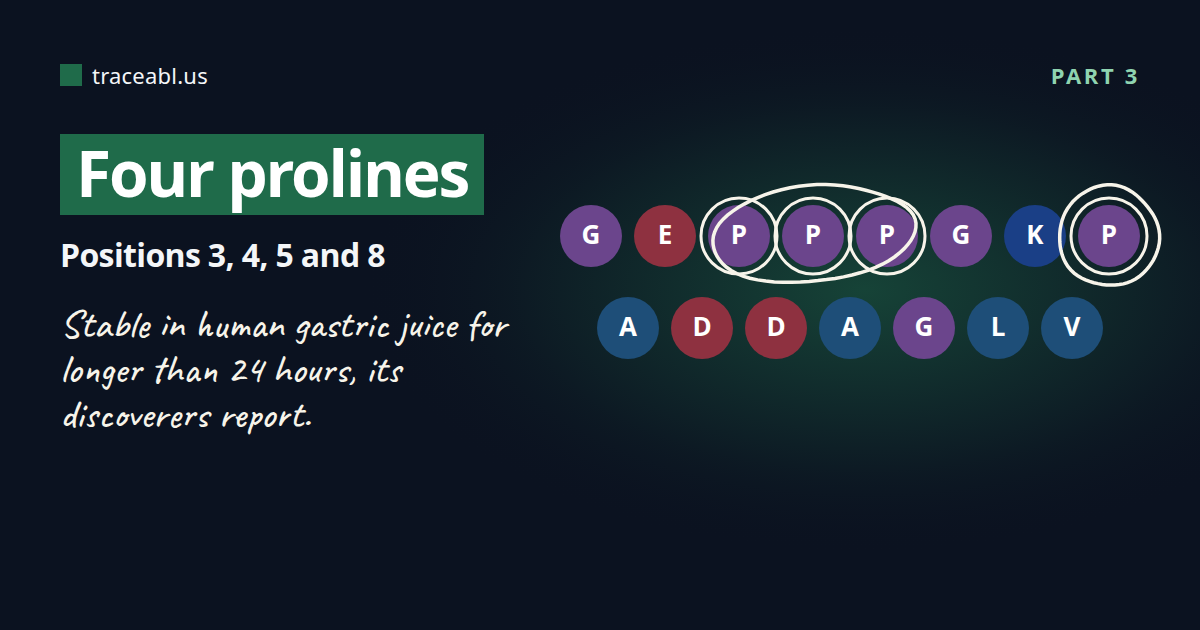
Gly-Glu-Pro-Pro-Pro-Gly-Lys-Pro-Ala-Asp-Asp-Ala-Gly-Leu-Val
Four of the 15 are proline, at positions 3, 4, 5 and 8.[3] Proline's side chain loops back onto the backbone in a ring, which stiffens the chain where it sits.[2]
Why does it hold up? The review offers a hypothesis. The run of three prolines near the front may take a shape called a polyproline II helix, which digestive enzymes have trouble getting at.[2] The review is clear this is still a hypothesis: BPC-157's 3D shape in solution hasn't yet been measured and published.[2]
What the sequence leaves out
The sequence has no cysteine, methionine, tryptophan, asparagine or glutamine.[3] Those building blocks are behind two common kinds of peptide breakdown, oxidation and deamidation. The review calls BPC-157's profile here "unusually favourable" compared with other linear peptides.[2] It names the bond between the two aspartic acids, at positions 10 and 11, as the likeliest weak point.[2] That's a prediction, not a measurement.
From gastric juice to your vial
A vial is a different setting: a powder or solution kept for weeks or months. Storage stability for BPC-157 hasn't been published yet: the review notes no standard stress tests,[2] and our search of PubMed, Europe PMC and Crossref on 27 Sep 2026 (PT) found no storage study.
Setting matters in interesting ways. A 2026 study from a doping-control lab in Ghent found that BPC-157 in blood serum broke down completely at 4 °C and 22 °C, yet not in plasma, and it stayed detectable in dried blood spots.[4] Same molecule, different surroundings.
That's the practical reason to test. An HPLC-UV purity result shows what's in your vial as measured: area % for that one sample, on the day it's tested.
What this means
Holding up in gastric juice is one of BPC-157's best-documented traits, and its sequence offers a plausible explanation that hasn't been confirmed yet.[2]
Next: Part 4, Questions the sources answer.
References
- Staresinic M, Japjec M, Vranes H, et al. Stable Gastric Pentadecapeptide BPC 157 and Striated, Smooth, and Heart Muscle. Biomedicines. 2022;10(12):3221. https://doi.org/10.3390/biomedicines10123221 (PMID 36551977)
- Mateescu DM, Gavrilescu DM, Constantinescu FE, et al. BPC-157 as an Investigational Peptide Therapeutic: Biopharmaceutical Challenges, Formulation Strategies, and Translational Development Barriers. Pharmaceutics. 2026;18(5):625. https://doi.org/10.3390/pharmaceutics18050625 (PMID 42198317)
- PubChem. BPC-157, CID 9941957. https://pubchem.ncbi.nlm.nih.gov/compound/9941957
- Mazzarino M, Colpaert T, Deventer K, Van Eenoo P. Rapid and harmonized analytical workflow for the determination of peptidic and non-peptidic doping agents in dried and liquid blood matrices. Analyst. 2026;151(15):4398–4413. https://doi.org/10.1039/d6an00455e (PMID 42328738)